Holy Trinity Episcopal School, Fruitland Park, to Fund Expansion Through $500K Grant
- Written by Nina Keck
- Length 4 minutes, 27 seconds
- Category All News & Content, Articles, Diocesan Family, Outreach, Stewardship
 Email
Holy Trinity Episcopal School in Fruitland Park has received a $500,000 state grant to support its expansion, including new classrooms and a dedicated facility for its Extended Transition Program. The funding will help the school continue providing personalized education and life-skills training to students with learning differences, empowering young adults with disabilities to build independence and prepare for meaningful careers.
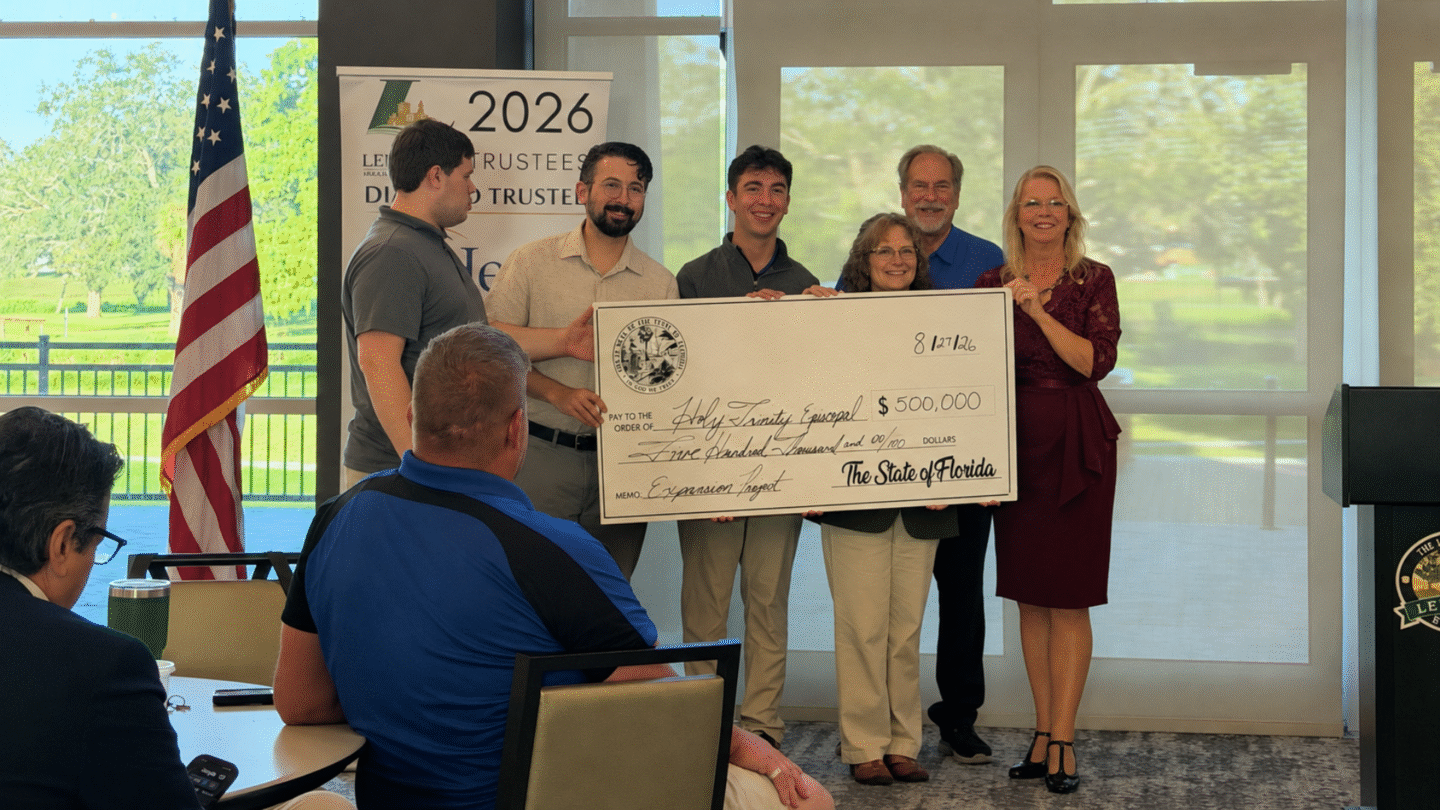
David Osborne, Extended Transition Program participant; Dr. Jordan Droira, Extended Transition Program coordinator; Gavin Skinner, HTES graduate and community liaison; Rebecca Coulter, head of school; Dr. Walter Zielinski, director of school growth and grants; Florida state Rep. Nan Cobb | Photo courtesy of HTES
On Aug. 27, Holy Trinity Episcopal School in Fruitland Park received a $500,000 grant to help fund its school expansion. State Rep. Nan Cobb presented the check at the Leesburg Chamber of Commerce Breakfast.
“The grant is an appropriations grant from the Florida legislature,” said Rebecca Coulter, head of school. “Appropriations bills passed by the legislature authorize the spending of public money for a fiscal year. Separate from this, Appropriations Project Requests allow members of the legislature to seek funding for specific projects. I wrote the grant and sought help from Cobb and state Sen. Keith Truenow. They visited the school and were so impressed they supported our grant request.”
HTES Fruitland Park serves students in grades 6 through 12 who learn differently and who need a smaller, more personalized instructional setting. The curriculum is specifically designed to meet the needs of students who experience learning differences related to autism, ADHD, dyslexia and other learning disabilities. HTES has a current enrollment of 46 students, and eight are enrolled in the Extended Transition Program.
Path to Independence
“The money will help us add at least four new classrooms plus a separate building for our recently added Extended Transition Program,” said the Rev. Samuel Nsengiyumva, rector of Holy Trinity, Fruitland Park. “The Transition Program is currently housed at a local Methodist church.”
The program serves students who have completed twelfth grade but are not quite ready to continue with college or work without assistance. “We are lighting a path to independence through the Transition Program,” Nsengiyumva said. “While all students and their families need to plan for life after high school, it is especially important for students with disabilities who may need additional support to transition successfully.”
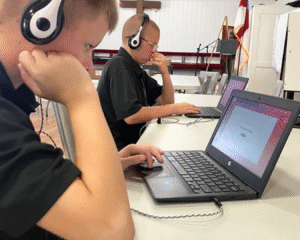
The Extended Transition Program provides a stepped-down support structure beyond high school. Here, young adults can begin seizing control of their lives, education and careers while maintaining access to experienced advisors, peer relationships and predictable daily schedules.
“We provide tools that young adults with disabilities can use to live as independently as they would like,” Nsengiyumva explained. “We firmly believe that a productive, fulfilling livelihood can be an option for everybody, regardless of ability, and it is our job to bring out the unique abilities.
“Our students start their day with an hour of outdoor physical activity,” he continued. “This can be as low- or high-impact as each person desires. Some choose to run laps; others walk and talk together. This helps build social skills, regulate nervous systems and creates an understanding of active, healthy lifestyles.
“The remainder of the morning is an office-style space,” Nsengiymva said. “Each student has a personal desk and computer with access to a variety of skill-building and learning resources. This learning time is unique for each student as they investigate their own areas of interest and expertise.
“At noon, everyone breaks for lunch together,” he said. “Then it’s time to pack up and go to work!
“Afternoons are spent with on-the-job learning,” Nsengiymva said. “We partner with programs that help us organize real jobs with real paychecks, giving our students hands-on experience and skill-building.”
Students rotate through jobs in a variety of fields and types of work. A career counselor helps them develop a directional goal for employment planning and then curates a job rotation to help refine the goal, gain experience or try something entirely new. Transportation is provided from campus to each jobsite, and parents pick them up from the jobsite.
Funding Challenges and Support
In Florida, students with a Section 504 Accommodation Plan or an Individualized Education Program qualify for extended enrollment in secondary school through the year they turn 22. Students with this documentation also qualify for the Unique Abilities scholarship from Step Up for Students for the same extended timeframe.
But HTES is facing significant funding challenges. “It costs about $16,000 a year to educate each student, but we only charge $11,200,” Coulter explained. “State scholarships cover about $9,200, which leaves parents to pay around $2,000 per child. About 50% of our students come from families below the poverty line who cannot afford the required parent contribution.”
To help with funding, the parish established the Light the Path Thrift Store, which opened on July 9 at 619 N. Dixie Ave. in Fruitland Park with all proceeds designated for the school. It has already established itself as one of the best thrift stores in the area. “
“Our Facebook page has over 400 followers, and the reviews are very encouraging,” Nsengiyumva said. “We continue our fundraising efforts, including a Banquet and Benefit in April, which raised over $40,000; and the Light the Path Golf Benefit on Oct. 19, which raised $30,000. We also receive support from community partners like the Lake Sumter Lions Club and the Jacobsen Foundation. These partners provide essential support for financial aid funding and educational technology costs.”
Nsengiyumva sees God’s hand in all of this. “That [$500,000 legislative] grant is from God,” he said. “He has made sure that we can help these precious young people.”
CFE Digital Digest
The CFE Digital Digest is our monthly email newsletter featuring timely news, stories, and updates between print issues of the Central Florida Episcopalian.