A Century in Stone: The Cathedral Church of St. Luke Celebrates 100 Years
- Written by Matt Green
- Length 5 minutes, 25 seconds
- Category All News & Content, Articles, Diocesan Family, Episcopal & Anglican News
 Email
Email
The Cathedral Church of St. Luke in Orlando celebrates 100 years since the dedication of its original nave, reflecting on a century of faith, resilience and growth. From its 1925 cornerstone to the completion of the Cathedral in 1987 and its ongoing preservation today, the congregation looks back with gratitude while carrying its legacy into the future.
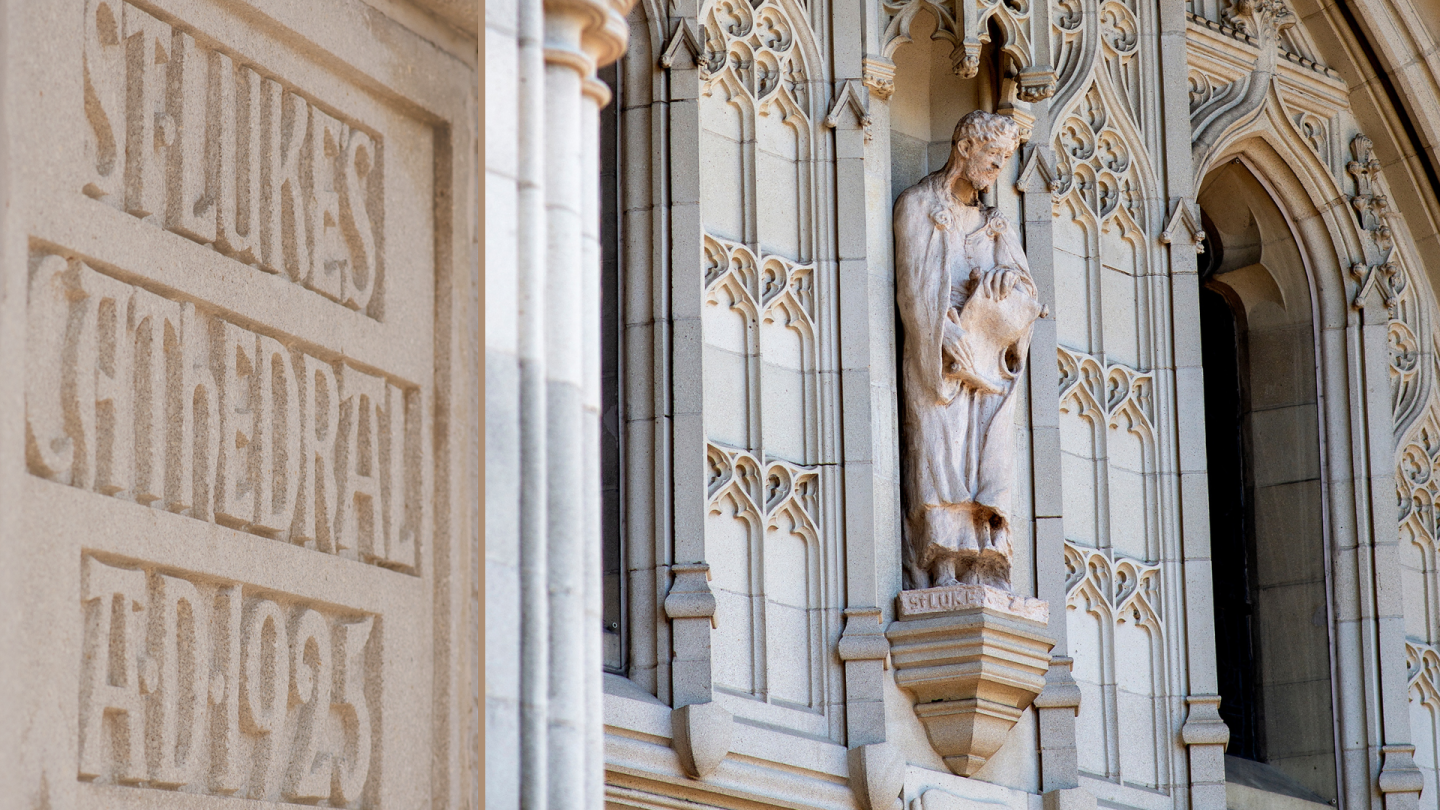
Photo: SCOTT BEAVIN
This year – two years after marking the 150th anniversary of its founding as a congregation – the Cathedral Church of St. Luke, Orlando, celebrates 100 years since its construction and dedication. Following the May 31 retirement of the Rev. Dr. Reggie Kidd, its 14th dean, the Cathedral now anticipates receiving its 15th dean, the Rev. Canon Curt Benham, on Dec. 1. But while looking ahead, the congregation that makes up the Cathedral is taking care to look back at the great things God has done.
In 1925, Orlando was a city in a hurry. The Florida land boom was at its frenzied peak, and the quiet citrus town that had counted barely 9,000 residents at the start of the decade was on its way to tripling in size, adding more than a dozen new subdivisions between 1924 and 1926 alone. Downtown, the Angebilt and San Juan hotels rose over brick-paved Orange Avenue, and more than half of Florida’s citrus crop rolled through the packing houses lining the railroad tracks.
On Easter Sunday, April 12, 1925, the cornerstone of a new Gothic cathedral was laid at the corner of Main Street and Church (now Magnolia and Jefferson) in downtown Orlando. One year later, on Easter Eve 1926, the nave of the Cathedral was completed and dedicated, replacing a simple wood-framed church that had been the congregation’s home since 1882.
But the parish’s history reaches back even further, to home prayer services held by Francis W. Eppes, a lay reader in The Episcopal Church and grandson of Thomas Jefferson who settled south of Orlando in 1869.
A Vision Built in Stone
Having outgrown its original wood-frame church, the parish retained the architectural firm of Frohman, Robb and Little – the same Philip Frohman who served as chief architect for the completion of the Washington National Cathedral – to design an elaborate Gothic Revival church.
Then the great Florida land boom collapsed. With the Great Depression soon to follow, the congregation decided to build only the nave and close it off with a temporary west wall, to be replaced when the full structure could someday be completed.
The temporary wall stood until 1986, when construction finally began to extend the Cathedral westward in keeping with the original design, adding the ambulatory and its stained-glass windows, the bell tower and the flying buttresses. The completed Cathedral was dedicated on Sunday, Oct. 18, 1987, 62 years after the cornerstone was laid and coinciding with St. Luke’s Day.
Walls That Witnessed
The century since 1926 has not been without peril. In February 1976, an arsonist set fire to the Cathedral’s carved oak altar, a 1908 gift from St. Clement’s Church in Philadelphia. The damage was extensive but isolated. Three years earlier, a renovation had moved the altar forward, away from the west wall; had it remained in its original position, the fire could have spread through the chancel. That Easter – the 50th anniversary of the nave’s dedication – the congregation returned from two months of services in the Great Hall to worship in its restored Cathedral.
The historic building is a treasury of features and artifacts that draw the congregation and visitors to worship and remind them of its history and the many faithful saints who contributed to its life through the years. There are highly visible items, such as the eagle lectern given in 1889 by a great-granddaughter of Thomas Jefferson and the rose window dedicated in memory of the Rev. Melville Johnson, the Cathedral’s sixth dean. And then there are more whimsical, yet equally meaningful, features such as a small shamrock worked into the 23rd Psalm window at the request of the Rt. Rev. O’Kelley Whitaker – who served as the Cathedral’s tenth dean and later became bishop of Central New York – honoring his Irish heritage.
Preserving the Century
As part of the centennial celebrations, the Cathedral community published a coffee table book documenting the building’s history, architecture, stained glass and people who shaped it – with more than 280 pages and over 200 photographs.
A Reflection of Faith: The Glorious Interiors of The Cathedral Church of St. Luke began with a three-ring binder assembled by retired Army Lt. Gen. Jay Garner, a lifelong Episcopalian and Cathedral member. The manuscript contained his reflections on the history of the Cathedral and descriptions of its many features.
“I have been in love with the Cathedral ever since the first day I entered,” Garner said. “As I stand in the nave and reflect upon its history with the grace and comfort it provides, St. Luke’s has been a sacred retreat. The furnishings, stained glass and other carefully crafted sanctuary elements testify to a worship community that seeks to glorify God through artistry and architecture.”
Garner entrusted the binder to Dillon White, a fellow parishioner and a Chapter member, in hopes that he could bring it to life. White considered the 150 pages Garner had assembled “a kind of map of the Cathedral, its story and its spirit.”
Turning the manuscript into a book took years and drew in talent from across the congregation, as well as outside experts such as a photographer who shot the clerestory stained glass in multiple exposures from the third level of scaffolding, a designer who created digital renderings that revealed masonry details too high for any visitor to see, as well as writers, editors, clergy, donors and volunteers throughout the Cathedral community.
“Ultimately, I don’t see the book simply as a keepsake, but as a record of beauty, a preservation of history and a legacy for the generations that come after us,” White said. “And for me personally, it’s also a testimony to God’s timing – how he can take a three-ring binder, put it in the right person’s hands and bring together an extraordinary group of people to create something none of us could have created alone.”
Copies of the book are available through the Cathedral; visit this link to learn more.
A century after its cornerstone was laid, the Cathedral continues to serve as the mother church of the Episcopal Diocese of Central Florida and a reminder of the faithfulness of a congregation that never saw its completion but entrusted it to those who came after. One hundred years on, that trust is still being preserved.
CFE Digital Digest
The CFE Digital Digest is our monthly email newsletter featuring timely news, stories, and updates between print issues of the Central Florida Episcopalian.