UN-Related Forum Helps Connect Safe Church, Justice Initiatives, Says DeLand Rector
- Written by Marti Pieper
- Length 7 minutes, 27 seconds
- Category All News & Content, Articles, Episcopal & Anglican News, Leadership
 Email
Email
The Very Rev. Audrey Sutton attended the NGO Commission on the Status of Women Forum 70 in New York to advocate for gender justice, safe church initiatives and the protection of vulnerable people. She emphasizes that issues like abuse, inequality and discrimination are human issues — not just women’s issues — and connects the Church’s mission of creating safe, inclusive spaces to broader global efforts for justice, reconciliation and social transformation.
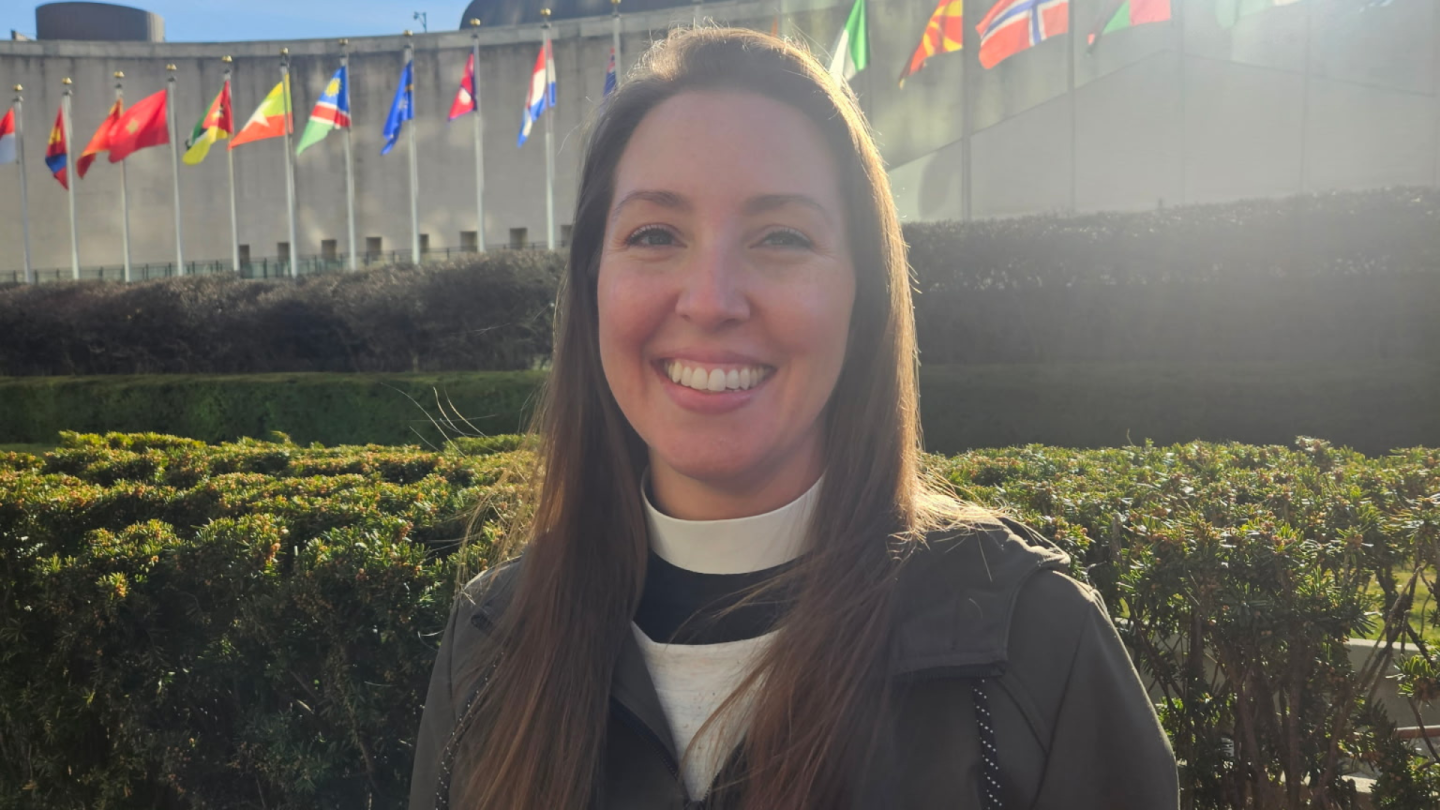
Mother Audrey Sutton in front of the U.N. Headquarters | Photo courtesy of the Very Rev. Audrey Sutton
For a picture of faith-driven hope in action, look no further than the Very Rev. Audrey Sutton, rector of St. Barnabas, DeLand; dean of the Northeast Deanery; and co-chair of the Safe Church Commission for the Episcopal Diocese of Central Florida. Representing the diocese in her role as Province IV co-link for the International Anglican Women’s Network, Sutton recently returned from the Nongovernmental Organization Commission on the Status of Women Forum 70, held in New York City this March in conjunction with the U.N. Commission on the Status of Women 70. The 2026 priority theme of both events was “Ensuring and strengthening access to justice for all women and girls, including by promoting inclusive and equitable legal systems; eliminating discriminatory laws, policies, and practices; and addressing structural barriers.”
The four days she spent at the NGO CSW70 gave her a great sense of encouragement regarding the Church. “I was there to network, learn and absorb,” she said. “We are already doing the hard work that needs to be done to create a safer world and a better understanding of the depth of this work: why this work is so important, why we need to create safe spaces, why we need to fight for the protection of the vulnerable.”
Sutton returned to Central Florida with three additional takeaways.
Takeaways From the NGO CSW70
- The presence of the Church matters. Although this was a secular conference, representatives of the Church were in attendance as both attendees and presenters.
The Anglican Communion (via various sources, including U.N. Women) reports that:
- Women still earn 20% less than men for the same job.
- Less than 50% of landowners are women.
- 1 in 3 women globally will be abused in her lifetime.
- Around 650 million women worldwide were married before age 18 (2018).
- Countries with domestic violence laws have seen fewer cases of violence against women.
Major Manikya Mera of the Salvation Army in Australia told the NGOCSW, “Inequality survives because it feels normal,” noting that equality is not a modern idea imposed on faith but one deeply rooted in the life and ministry of Jesus. Holiness, which includes justice, comes from God alone; people and creation are both holy through their relationship with God.
In view of both the good work accomplished and the great need for more, Sutton hopes to return, potentially to UNCSW itself rather than the NGOCSW. She said the presentations, ecumenical worship, networking and discussions showed her that “The UNCSW is not a place of abstract policy-making; it is where global frameworks are being shaped for justice, legal access, reform and equality.”
“We care, and we are at the table,” Sutton said. “We are fighting for change.”
- Justice is a human issue. “More than any other entity, the Church respects the dignity of every human being,” Sutton said. “Our churches have a large number of congregants who are women. But this is not a women’s issue; this is a human issue. ‘Gender justice’ refers to people who are being oppressed, harmed and suffering from injustice based on their gender, no matter what gender that may be. If we are going to say no to abuse, if we are going to say no to oppression, if we are going to create safe places for people to flourish and learn the gospel and love the Lord, then we have to say no to whatever is harming people.
“This is an issue that impacts Florida, that impacts the U.S., that impacts our continent, that impacts our brothers and sisters on the other side of the world,” she continued. “As Christians, we know that we are the body of Christ, and we read in scripture that what harms one believer harms the whole body. … Justice is something for the Church – the worldwide body of Christ – to care about and work toward. As Episcopalians, in our Baptismal Covenant, we promise to respect the human dignity of each person.”
- The work of gender justice ties into our abuse prevention in Central Florida in that it names abuse and a path toward reconciliation. “One of the sessions I sat in on was called ‘Breaking Structural Barriers,’” Sutton said. “In this presentation, Carolyn Handschin [president of the NGO Committee on the Status of Women] looked at the social barriers within our world.
“Handschin said mutual respect needs to be cultivated for all members of society,” Sutton said. After looking at both patriarchal and matriarchal societies, both of which have been helpful in building structures, the speaker presented her own ideas on “familiarchy,” which Sutton described as “a form of social organization in which the family unit is the driver.” Per Handschin, this social construct would offer a new form of citizenship that brings about honor, goodness, beauty, truth and love.
“But of course, not everyone is called to have a biological family,” Sutton said. “I think this sounds a whole lot like the Church. As the Church, we are called to break structural barriers that are oppressive and harmful to people, whatever they are: racism, sexism, abuse toward children, domestic abuse. We are called to be a part of that chain-breaking, oppression-erasing gospel truth that Jesus has called us to. He has given us freedom, and we need to help other people find that or recognize that so they can walk with him toward that.”
“As we look at our safe church policies, as we look at how to create safeguarded areas, that’s what we’re doing,” she said. “We’re trying to create these microcosms of civil society within our churches where people, including children, can grow into who they’re supposed to be, not based on gender, race, economic status or anything like that, but on who God made us to be. And we are working to create safe spaces for people to do just that.”
Gender Justice and Safe Church
Days away from helping lead the May 12 diocesan-wide webinar, “Leading Safe Churches: People and Policies” the diocese’s official safe church training for 2026, Sutton has a particular calling for connecting gender justice to safe church initiatives.
“Handschin stressed that this is a grassroots effort; well, I see the Church as the grassroots effort,” she said. “Right now, when we’ve got gaps in funding, the Church shows up. When we have gaps in care after an emergency, the Church shows up. Sometimes the Church is there beforehand, meeting the needs before others do. We are already actively creating safe spaces in our churches and communities, doing the grassroots efforts that will not only shape the kingdom but the future of our civil society.”
“In the Salvation Army presentation, they discussed some things the Church can do to engage with this issue,” Sutton said. “The No. 1 thing they listed that the church can do to make a difference was safety and safeguarding, especially when it comes to protecting the vulnerable and gender justice.”
“What we pour into our young people is inevitably going to change our world,” she added. “Jesus is the bridge; he’s the gate that opens our way to heaven, to eternity. We get to mirror that in our world by being a bridge and saying to others, ‘Hey, come see freedom. Come see hope. Come see life.’”
Sutton also found ties to safe church work in a presentation she attended on domestic violence led by Annika Svensson of Norway, who started a program to rehabilitate violent perpetrators and abusers. “This was one of the most hopeful models presented,” Sutton said. “It challenged the assumption that violence is fixed – and instead showed transformation is possible with early intervention and accountability.” Sutton saw an example of this in a former parish she served, where ministry to a former abuser included the restoration of him and his family.
“Once again, this is not a women’s issue; this isn’t a children’s issue; this is a people issue,” she said. “There are some amazing people who have done hard work for many years, and they haven’t seen change; they haven’t seen development. And yet they still fight because they believe that what Jesus said is true. Because they follow the gospel, they have hope that there is freedom and that we can help lead people out of Egypt.”
CFE Digital Digest
The CFE Digital Digest is our monthly email newsletter featuring timely news, stories, and updates between print issues of the Central Florida Episcopalian.