Retreat for Prospective Deacons Celebrates Culmination of 3-Year Formation Process
- Written by Marti Pieper
- Length 10 minutes, 18 seconds
- Category All News & Content, Articles, Diocesan Family, Leadership
 Email
Email
Five prospective deacons in the Episcopal Diocese of Central Florida gathered for a retreat of reflection, worship and fellowship as they prepared for ordination this October. The retreat marked the culmination of the diocese’s three-year deacon formation program and celebrated their journey into ordained ministry.
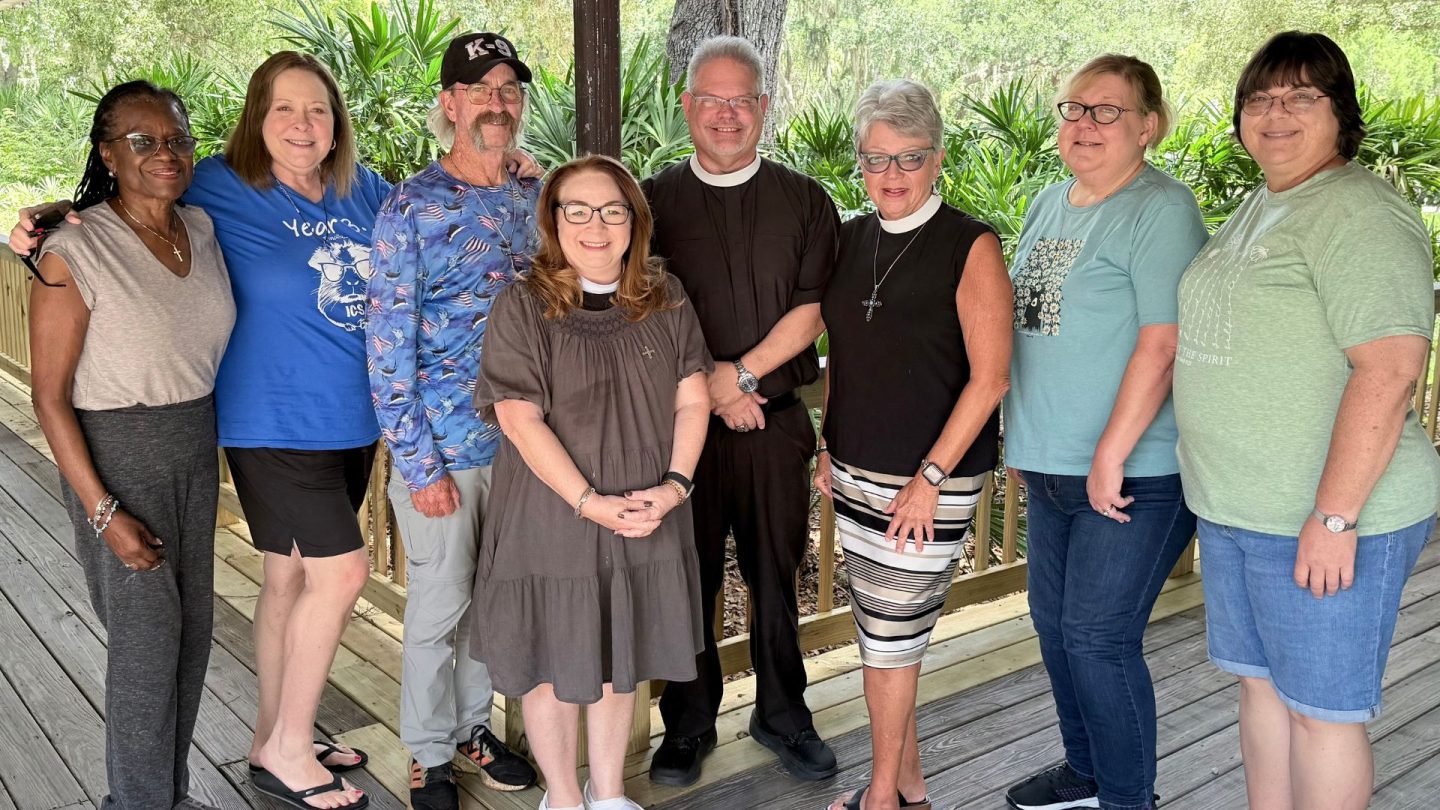
The prospective deacons and their leaders at Dayspring Camp & Conference Center: Carol McFarlane, Margaret Emerson, Dennis Hartenstein, Archdeacon Julie Altenbach, Father Rob Strenth, Rev. Kay Mueller, Jane Surko and Laura Murray | Photo courtesy of ICS
What do you get when you take five prospective deacons from the Episcopal Diocese of Central Florida, walk with them through a three-year intentional process toward the diaconate, and lead them in a final time of relationship, rest and reflection?
In the case of the Ven. Julie Altenbach, archdeacon for the diocese, you end up with five strong Christ-followers, fully prepared for ordination as deacons, and a wonderful retreat – held July 24-25 at the Episcopal Diocese of Southwest Florida’s DaySpring Camp & Conference Center – that helped them think even more deeply about the faith and calling that brought them together.
Altenbach, who serves alongside the Ven. John Motis, archdeacon for discernment (unable to attend the retreat due to a family obligation), planned and led the retreat with the Rev. Kay Mueller, member of the Standing Committee and the Commission on Ministry and rector of Church of Our Saviour, Okeechobee; and the Rev. Dr. Rob Strenth, chaplain for the Order of the Daughters of the King® for the Episcopal Diocese of Central Florida, member of the Standing Committee and the Commission on Ministry, and rector of St. Matthew’s, Orlando.
‘Guinea Pigs’
The July retreat served as the final component of a three-year deacon formation process. Three years ago, as a brand-new archdeacon charged with the task of reshaping that process, Altenbach jokingly termed the five prospective vocational deacons (those who do not intend to pursue ordination as priests) her “guinea pigs.” The name stuck, and the five not only accepted but embraced this identity, even creating various T-shirts featuring the rodents that they wore during their journey toward ordained ministry.
The five guinea pigs are as follows: Margaret Emerson, sponsored by St. Thomas, Eustis, assigned to Holy Spirit, Apopka; Dennis Hartenstein, sponsored by and assigned to St. Thomas, Eustis; Carol McFarlane, sponsored by St. Thomas, Eustis, assigned to Ascension, Orlando; Laura Murray, sponsored by and assigned to Church of Our Saviour, Okeechobee; and Jane Surko, sponsored by Church of the Good Shepherd, Maitland, assigned to St. Matthew’s, Orlando. The Rt. Rev. Dr. Justin S. Holcomb will ordain these five along with a group of transitional deacons, on Saturday, Oct. 10, at 11:00 a.m. at the Cathedral Church of St. Luke, Orlando.
“I was building the program as they were embarking on it,” Altenbach said. “And, as I told them at the retreat, I really believe God called them to discern their call to be the first ones to go through it because their faith in God, which spilled over into their faith in me, created a formation program that has just been astounding. Their faith helped me get the process and formation where it is now.
“The first year of the program is all foundational, exploring what the call is,” she explained. “It’s not uncommon at the end of Year One for quite a few people to say, ‘You know what? I thought I was headed toward the diaconate, but it’s really the priesthood, or the Order of St. Luke or something else entirely.’
“Bishop Justin says, ‘We’re all called. It’s just a matter of which path we’re called to,’” Altenbach said. “That first year of formation is really designed to help them make sure they know the path they’re called to. They get biblical and theological foundations. They get a course on evangelism. There’s a course on who are the ministers of the church, so it’s really more about identifying who they are in Christ and what their call really looks like.
“And then from there, they go into Year Two,” Altenbach explained. “Year Two and Year Three really build and drill down on what it means to be a deacon, moving into true formation. At the end of Year One, they will hear about doing an externship, and then they will have all of Year Two to do it. In the externship, they go into a nonprofit, a hospital or another place where they volunteer for at least 20 hours. The externship comes with the purpose of understanding what their role as a deacon might look like, because the deacon has one foot in the world, one foot in the church. It’s designed to get them into the mindset of a deacon as a servant in the world, and then Year Three is where they’re doing their field work, which we now call ‘internship.’ They serve at a church – not their home church – under the supervision of a rector, learning how to be a deacon.
“In addition, they are taking in-person classes at the Institute for Christian Studies and online through Thirdmill,” she said. “At every single one of our in-person classes, we hold a worship service where the students take leadership. There’s a service leader. Someone is doing the Prayers of the People and the reading. One of them is giving a homily. They’re preparing the altar. Other than celebrating and reading the Gospel and the dismissal, which are done by our priest instructors, our students are doing the rest. They’re learning how to serve as deacons, and while they’re in ICS, they’re very involved in practical application of what that means.”
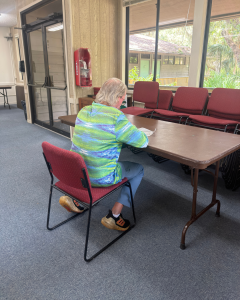
“The program is excellent,” said Hartenstein, who first sensed a “nudge” toward his calling when his rector, the Very Rev. Matthew Perreault, dean of the Northwest Deanery, announced an upcoming Conference on Ministry. “When Archdeacon Julie and I talked at the retreat, I told her the program is really well-rounded. I’ve been out of school for 50 years, and if I could do it, anybody could.”
Hartenstein praised both the in-person ICS classes and the online classes offered through Thirdmill, a component Altenbach instituted during the guinea pigs’ formation. He especially enjoyed the fact that he could rewatch the associated videos and take the accompanying quizzes more than once if needed. Originally, he felt unsure if he could finish the formation process due to his lack of educational experience. But the Thirdmill courses met his needs so well that he completed them all before the end of his second year in the process.
Surko agrees that the diocese’s reworked deacon formation program is top-notch. “We all told Archdeacon Julie, ‘Don’t change a thing,’” she said. “I think that once more people hear about this program, she’s going to have people come from all over the country saying, ‘Tell us more. Come teach us; come talk to us.’ Because I can’t imagine there being a better program.”
For additional information on ICS and the deacon formation process, visit this link. Altenbach also urges those sensing a call to the diaconate to consult with their rector for assistance in attending the Conference on Ministry, held annually in August, and more.
Transition and Celebration
The retreat served as the final component of the formation process for the five prospective deacons. Similar gatherings have taken place through the years under the leadership of various priests, and when Altenbach completed her own deacon formation, she and her fellow trainees planned a retreat of their own.
Motis and Altenbach meet weekly by phone to discuss deacon formation and any concerns that come up along the way. Together, they have built diocesan deacon formation into a life-changing experience that leaves candidates fully prepared for ordination and its accompanying responsibilities. “We work so well together, and decisions are made together,” Altenbach said. They chose to bring back the retreat as a means of celebrating God’s work through that process and helping the candidates move toward ordination.
“There needed to be a way to honor and recognize all the work that happened and to help them transition from where they were to where they’re going,” she said. “So, I started thinking about what that would look like, and being at a camp where we could all be together would be a real gift. I called Dayspring, and from the beginning, they bent over backward to accommodate us and be so hospitable.”
The group stayed in three cottages, meeting for meals and social time as well as individual reflection, guided meditation and collective worship. “Father Rob, Rev. Kay and I shared the work on the meditations and rotations they did around campus, and we ended with the Eucharist,” Altenbach said. “The homily consisted of all five sharing about their experiences, both on the retreat and during the entire process. For me, and from what I understand from each of the candidates, the whole weekend was a powerful way to transition from formation into ministry.”
“For one of the rotations, Father Rob and Rev. Kay were in two separate places for confession and reconciliations,” she added. “The participants were told ahead of time about this rotation because I didn’t want them to be caught by surprise, and I wanted them to have the opportunity to think through whatever was weighing them down. Afterward, they talked about how powerful that was, and how many of them had never participated in confession. The culmination of the retreat was that they got a certificate of completion from the Institute for Christian Studies to signify the ending to their formation process as they move toward ordination.”
Responses to the Retreat
As with the deacon formation process in general, the deacon candidates had high praise for the retreat. “One thing that was so great about it was that it was so well-organized,” Surko said. “Archdeacons Julie and John and Father Rob and Rev. Kay, they had just done such a great job, and we had so many different activities designed to increase your prayer life and make you feel closer to God. … It just brought so much peace, something I haven’t felt in a very long time.”
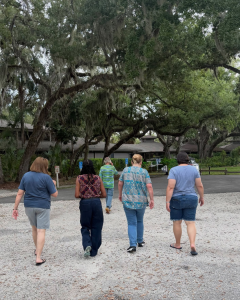
Taking time out for the retreat also left Surko with a lesson that she believes will impact her future ministry. “It was a great time just to center ourselves, have fellowship with each other before we go out and begin the work of our ministry, and just have time to draw ourselves closer to God,” she said. “It also taught me that when you’re in ministry, there are times when life happens, and you know you can have some tough times. … sometimes, you need to break away and be alone. That’s what Jesus did. He prioritized it, and this retreat showed me that it’s going to be something we’ll all need to prioritize.”
Hartenstein said he also gained a great deal from the retreat. “I didn’t know what to expect, but it was very well laid-out,” he said. “We had different meditations that we did individually, but we got together as a group too. Over the years, you form a bond with your team members – that’s what I call them – that’s basically unbreakable, and this was our last time together before ordination.”
The retreat’s co-leaders also saw the value of the time spent together. “The retreat was a very special time of worship, activities, reflection and fellowship as we gathered with the five candidates for ordination to the Sacred Order of Deacons,” Mueller said. “It was a celebration of the culmination of three years of discernment, study, sacred bonds, tears, laughter, perseverance and faith. Thanks be to God for the blessing of being part of their spiritual and educational formation … and sharing the anticipation of their upcoming ordination in ministry!”
“The retreat was a perfect capstone to the three years the students have been engaged in coursework at ICS, Third Millenium Seminary and completion of both an extern and internship,” Strenth explained. “It was both an excellent recap of the work done and a preparation for their ordained ministry and lives. It combined amazing individual spiritual exercises, periods of reflection and time to celebrate their accomplishments.”
CFE Digital Digest
The CFE Digital Digest is our monthly email newsletter featuring timely news, stories, and updates between print issues of the Central Florida Episcopalian.