Webinar Highlights Updated Safe Church Policy, Implementation Training
- Written by Marti Pieper
- Length 6 minutes, 43 seconds
- Category All News & Content, Articles, Diocesan Family, Episcopal & Anglican News
 Email
Email
The Episcopal Diocese of Central Florida recently hosted its annual safe church training, a webinar unveiling updated safeguarding policies and resources designed to strengthen cultures of safety, accountability and care throughout the diocese. Diocesan leaders and safeguarding experts emphasized that creating safe churches is both a gospel imperative and a shared responsibility, with practical guidance focused on faithful, sustainable implementation in every parish.
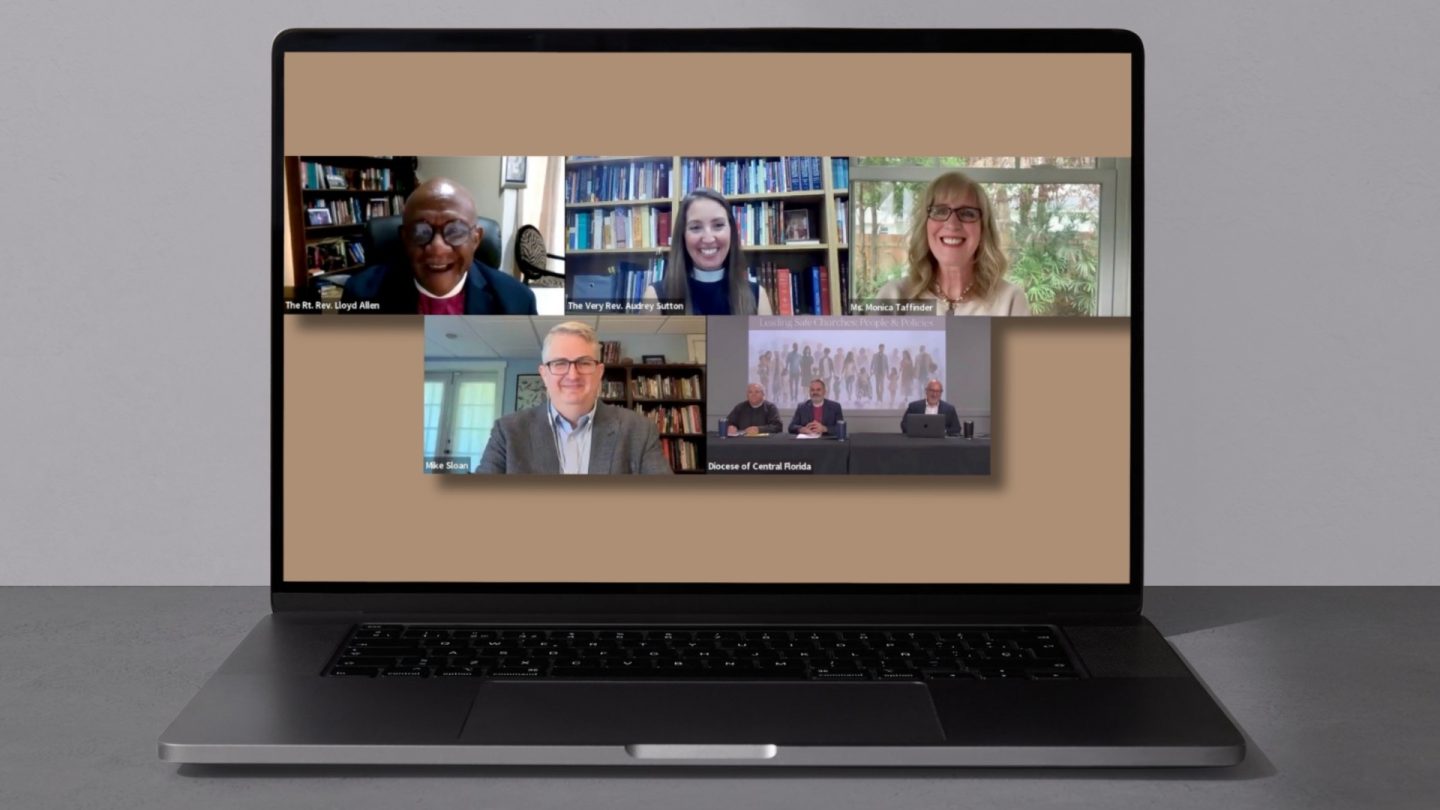
For years, safe churches have been a top priority of the Episcopal Diocese of Central Florida and its bishop, the Rt. Rev. Dr. Justin S. Holcomb. In fact, even prior to Bishop Holcomb’s episcopacy, the diocese was known for its robust safe church policies. That emphasis rose to the forefront again in with this year’s safe church training, a May 12 diocesan-wide webinar, “Leading Safe Churches: People & Policies,” which highlighted key policy updates, explained why strong policies matter, and offered practical guidance for implementing them faithfully and effectively in parish life.
Planned and hosted by Erik Guzman, diocesan director of communications, the webinar featured Bishop Holcomb; the Rt. Rev. Lloyd Allen, bishop of the Episcopal Diocese of Honduras; the Rev. Canon Dr. Dan Smith, canon to the ordinary for the Diocese of Central Florida; the Rev. Mike Sloan, director of safeguarding at GRACE (Godly Response to Abuse in the Christian Environment); the Very Rev. Audrey Sutton, rector of St. Barnabas, DeLand, dean of the Northeast Deanery, Province IV co-link for the International Anglican Women’s Network and Safe Church Commission co-chair; and Monica Taffinder, mental health therapist, co-founder and CFO of Grace Clinic Christian Counseling, Winter Park, and Safe Church Commission co-chair.
In addition, the session introduced diocesan resources, including a new Safe Church Training Video Library, funded in part by a $10,000 grant from the office of the Most Rev. Sean W. Rowe, presiding bishop of The Episcopal Church, with the goals of partnering with another bishop around the safe church topic and making the training resources available to other dioceses. These resources include the two previous annual safe church diocesan-wide trainings: “Shedding Light on Abuse: Prevention and Response,” May 16, 2024, and “Leading Safe Churches: Understanding Emotional and Spiritual Abuse,” April 29, 2025.
Find the updated policies in English and Spanish along with the entire Safe Church Training Video Library, which includes the webinar recording, at this link. NOTE: To access the video library, please contact the diocesan office using this link to request your password.
Bishops’ Involvement
At the start of the webinar, the two bishops emphasized the importance of their involvement in safe church policies now and in the future. “The church should be the safest place in the world, and when the church fails to do that, it causes confusion and harm,” Bishop Holcomb said. “It causes confusion for those who are survivors, wondering why it’s not safe, and for those who are not inside the church, it causes them to be repelled. … And the other reason for bishops [being involved] is that the protection of the church, the safeguarding of God’s people, is entrusted to bishops.”
“Bishop Justin and I think that it’s a key part of the mission of the church to create communities in which all people are safe and cared for,” Bishop Allen said. “The conviction must be a core component of our theology. … It must be a characteristic of our identity and thinking, words and actions in being God’s Church everywhere and wherever we are.”
The two bishops also pointed out that safe church was one of the calls discussed at the 2022 Lambeth Conference, signifying its importance to the worldwide Anglican Communion. “This is not just my issue or Bishop Allen’s issue,” Bishop Holcomb said. “This is our issue.”
Policy Revision
“My hope is that this will not be cumbersome or burdensome to those that are leading churches in our diocese but will come as a support and a structure to help them be better priests and deacons, protecting our churches, creating spaces for all our people to flourish,” Sutton said ahead of the webinar. “These aren’t blind statistics. These are flesh-and-blood human beings we’re talking about. I’m hoping that the release of the revised policies allows those who are leading churches to show up with confidence for their people.”
“For me, this revision started three years ago when Bishop Holcomb was first elected,” Smith said. “We made it a point to take a look at safe church right from the beginning of the three years that we’ve shared in this office.” He explained that the diocese had developed multiple policies for various age groups through the years, so the team chose to develop a more cohesive document.
Over time, the policies had also become outdated, he explained. “Information changes; best practices change. … Often the policies were vague in terms of implementation and accountability.”
To that end, Bishop Holcomb tasked Smith, Sutton and Taffinder with the arduous task of reviewing and revising the policies before their review by Sloan. The entire process, which involved multiple revisions, reviews and edits, took more than two years to complete.
“Effective policies are about the whole community, because safety is a feature of the whole community,” Sloan said, adding, “As Christians, we know loving our neighbor as ourselves is not something we check off and then move on; it’s something we grow in. And it’s the same with protecting others and having genuine environments of safety and respect. … From my view, we were just taking some natural steps forward because the policies were already in a really solid place.”
“We need to remember that as we talk about safe church, as we talk about both perpetrators and victims, we need to remember there are really three classes of victims,” Smith said. “There’s a primary victim, the person who’s been abused. There’s a secondary set of victims, usually the family of either the perpetrator or the immediate family of the victim. And there’s a tertiary victim in all this too, and that is the entire body of Christ. … as we talk about prevention, really, we’re talking about the safety of everybody.”
Progressive Implementation
The webinar also included a practical section – the how-to of policy implementation – led by Sloan, and then additional practical considerations, explained by Smith, Sutton and Taffinder with support from both bishops.
Despite the volume of material covered in the revised policies, both Sloan and Smith encouraged diocesan leaders not to fall into the trap of trying to make huge changes all at once. “We are committed to incremental progress,” Sloan said, urging leaders to start small, then build consistent progress.
“This is the gospel played out in people’s lives,” Taffinder said. “And I would love for us to be a diocese where people can truly look back and say, ‘They believed me; they helped me; they supported me.’ And I think that’s what these policies are setting us up to do.”
“Creating safe churches is about discipleship; being safe people begins with being gospel-focused,” Sutton said. “When we aim to respect the dignity of every human being and love our neighbor as ourselves, we create communities and churches that reflect the heart of Christ.”
“I’m encouraged by how well the webinar went, and thrilled that we’re turning a corner on safe church implementation,” Taffinder said. “This is so much more than changing policy. This is about nurturing a culture of safety that’s fortified by people caring for each other.”
Bishop Holcomb summed up both the policy revision and the webinar, saying, “The gift that the team has given to us has covered all of the bases on this [topic] in a magnificently safe, expert-driven, matching current standards, in the gospel authority of scripture and the heartbeat of the Christian tradition.”
As a reminder, find the updated policies in English and Spanish along with the entire safe church training video library, which includes the webinar recording, at this link. REMINDER: To access the video library, please contact the diocesan office using this link to request your password.
CFE Digital Digest
The CFE Digital Digest is our monthly email newsletter featuring timely news, stories, and updates between print issues of the Central Florida Episcopalian.